Course Schedule
| Jun, 2026 | Weekdays | Mon-Fri | Enquire Now |
| Weekend | Sat-Sun | Enquire Now | |
| Jul, 2026 | Weekdays | Mon-Fri | Enquire Now |
| Weekend | Sat-Sun | Enquire Now |
The Ultimate Guide to Understanding Murex Architecture
Murex Architecture forms the technological backbone of the Murex platform, one of the world's leading trading, risk management, treasury, and post-trade processing solutions used by global banks, financial institutions, and capital market organizations. It provides a scalable, secure, and high-performance framework that enables financial firms to manage complex trading operations across multiple asset classes, including equities, fixed income, foreign exchange, commodities, and derivatives. Designed to support enterprise-wide operations, Murex Architecture integrates front-office, middle-office, and back-office functions into a single platform. It ensures seamless data flow, real-time trade processing, accurate risk calculations, regulatory compliance, and efficient settlement processes. The architecture combines powerful application servers, centralized databases, integration services, pricing engines, workflow management, and reporting tools to deliver a unified trading ecosystem. One of the biggest strengths of Murex Architecture is its modular and flexible design, allowing organizations to customize workflows, integrate with third-party systems, and scale infrastructure as business needs grow. It also supports cloud deployment, high availability, disaster recovery, and robust security mechanisms to meet modern banking requirements.
Understanding Murex Architecture is essential for developers, solution architects, business analysts, system administrators, and finance professionals who want to implement, manage, or optimize the Murex platform. A strong understanding of its architecture helps organizations improve operational efficiency, reduce risks, enhance system performance, and accelerate digital transformation in today's rapidly evolving financial markets.
What is Murex Architecture?
Murex Architecture refers to the structured framework that powers the Murex platform, enabling financial institutions to manage trading, risk management, treasury operations, collateral management, and post-trade processing through a unified system. It combines multiple technology layers, including the user interface, application servers, business logic, databases, integration services, and reporting modules, to ensure seamless execution of financial transactions across various asset classes. Designed for scalability, security, and high performance, Murex Architecture Training supports real-time trade processing, market data management, pricing, risk analytics, regulatory compliance, and settlement operations. Its modular design allows organizations to integrate with third-party applications, customize workflows, and expand infrastructure according to business requirements. Today, Murex Architecture plays a vital role in helping banks and financial institutions improve operational efficiency, reduce risks, and adapt quickly to changing market conditions.
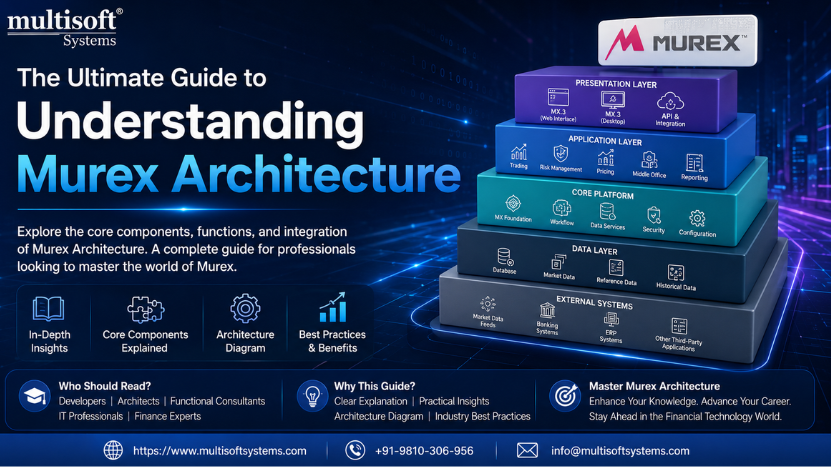
High-Level Murex Architecture Diagram
The high-level Murex Architecture illustrates how different system components interact to deliver end-to-end trading and risk management services. The architecture follows a layered approach where users access the platform through client applications connected to centralized application servers. These servers execute business logic, pricing models, workflows, and risk calculations while communicating with the database for data storage and retrieval. The platform also integrates with external systems such as market data providers, payment gateways, SWIFT, ERP solutions, and regulatory reporting systems. This architecture ensures smooth data flow, secure communication, high availability, and efficient processing of financial transactions across the organization.
Major Components
- User Interface (Desktop/Web Clients)
- Application Server Layer
- Business Logic Layer
- Workflow Engine
- Pricing & Valuation Engine
- Risk Management Engine
- Oracle Database Layer
- Market Data Management
- Integration Services (API, MQ, XML, REST)
- Reporting & Analytics Module
- Security & Access Control
- External Systems Integration
- Batch Processing Services
- Monitoring & Administration Tools
Murex MX.3 Architecture Overview
- Modern enterprise-wide capital markets platform
- Supports front, middle, and back-office operations
- Modular and service-oriented architecture
- Multi-asset trading support
- Real-time trade processing capabilities
- Integrated risk management framework
- Advanced pricing and valuation engines
- Centralized data management
- Flexible workflow configuration
- High-performance application servers
- Seamless third-party system integration
- Cloud-ready deployment architecture
- High availability and disaster recovery support
- Built-in regulatory compliance capabilities
- Scalable infrastructure for global financial institutions
- Comprehensive reporting and analytics
- API, XML, REST, and messaging support
- Enterprise-grade security and user management
- Batch processing and scheduling services
- Supports digital transformation initiatives in banking
Murex Technical Architecture
Murex Technical Architecture is designed to provide a secure, scalable, and high-performance environment for enterprise trading operations. It consists of client applications, application servers, business services, Oracle databases, middleware, messaging systems, and integration frameworks that work together to process millions of financial transactions efficiently. The architecture supports multiple operating systems such as Linux and UNIX, while Java-based services, APIs, XML messaging, and web services enable seamless communication between internal and external applications. Advanced caching mechanisms, load balancing, distributed computing, and parallel processing help optimize system performance even during high trading volumes. Security features such as authentication, authorization, encryption, and audit logging ensure data protection and regulatory compliance across the entire platform.
Murex Workflow Architecture
Murex Workflow Architecture automates and manages the complete lifecycle of financial transactions from trade capture to final settlement. Every transaction follows a predefined workflow that includes trade validation, approvals, confirmations, pricing, risk calculations, accounting, settlement, and reporting. The workflow engine ensures that each process is executed according to business rules and regulatory requirements while minimizing manual intervention. Organizations can customize workflows to match their operational needs, automate repetitive tasks, and improve collaboration between front-office, middle-office, and back-office teams. This structured workflow improves operational efficiency, reduces processing errors, accelerates transaction processing, and provides complete visibility into every stage of the trade lifecycle.
Murex Environment Architecture
Murex Environment Architecture consists of multiple environments that support software development, testing, validation, deployment, and production operations. Typically, organizations maintain separate Development (DEV), System Integration Testing (SIT), User Acceptance Testing (UAT), Production (PROD), and Disaster Recovery (DR) environments to ensure stable and secure application management. Each environment serves a specific purpose, allowing developers to build new features, testers to validate functionality, business users to verify requirements, and production teams to execute live trading activities without affecting system stability. This multi-environment approach minimizes deployment risks, supports controlled release management, and ensures business continuity through backup and disaster recovery mechanisms.
Common Challenges in Murex Architecture
Although Murex Architecture is highly robust and scalable, organizations often face several implementation and operational challenges. Integrating Murex with legacy banking systems, market data providers, ERP platforms, and third-party applications can be complex and time-consuming. Performance optimization becomes challenging as trading volumes increase, requiring efficient database tuning, infrastructure scaling, and application optimization. Customizing workflows, managing software upgrades, ensuring regulatory compliance, and maintaining data consistency across multiple environments also demand significant technical expertise. Additionally, organizations must address security concerns, infrastructure costs, cloud migration strategies, disaster recovery planning, and skilled resource availability. Overcoming these challenges requires careful architecture planning, continuous monitoring, automation, and adherence to industry best practices to ensure optimal system performance and long-term business success.
-
Treasury Architecture in Murex
Treasury Architecture in Murex is designed to help financial institutions efficiently manage treasury activities through a centralized and integrated platform. It provides complete visibility into cash positions, liquidity, funding requirements, investments, and financial risks while supporting real-time decision-making. By connecting front-office, middle-office, and back-office operations, Murex streamlines treasury processes, automates workflows, and ensures regulatory compliance. The architecture also integrates with banking systems, payment networks, market data providers, and accounting applications, enabling organizations to optimize cash utilization, reduce operational risks, and improve overall financial performance.
-
Treasury Operations
Treasury Operations in Murex cover the end-to-end management of an organization's financial assets, liabilities, and market activities. The platform enables treasury teams to execute, monitor, and settle transactions across multiple financial instruments, including money market products, foreign exchange, bonds, derivatives, and fixed-income securities. It automates trade capture, confirmations, settlements, accounting entries, and reporting while providing real-time visibility into treasury positions. By centralizing treasury activities, Murex improves operational efficiency, minimizes manual errors, and supports faster decision-making.
-
Cash Management
Cash Management is a critical component of Murex Treasury Architecture that enables organizations to monitor and control cash flows across multiple accounts, currencies, and business units. The platform provides real-time information on cash balances, incoming and outgoing payments, and cash forecasts, helping treasury teams maintain optimal liquidity levels. Automated reconciliation, payment processing, and bank connectivity reduce operational complexity and improve financial accuracy. Effective cash management allows organizations to maximize the use of available funds, minimize idle cash, and ensure timely payments to vendors, customers, and financial institutions.
-
Liquidity Management
Liquidity Management in Murex helps financial institutions maintain sufficient funds to meet their short-term and long-term financial obligations. The platform continuously monitors cash inflows, outflows, investment positions, and funding requirements, allowing treasury professionals to forecast liquidity needs accurately. Advanced analytics and reporting tools provide insights into liquidity gaps, stress scenarios, and regulatory liquidity ratios. Murex also supports compliance with global banking regulations by generating liquidity reports and enabling organizations to optimize asset allocation, reduce funding costs, and strengthen financial stability during changing market conditions.
-
Funding Operations
Funding Operations in Murex focus on managing the financial resources required to support business activities and trading operations. The platform assists treasury teams in planning borrowing strategies, managing short-term and long-term funding sources, issuing debt instruments, and optimizing funding costs. It provides real-time monitoring of funding positions, maturity profiles, interest rate exposure, and financing requirements. Murex integrates funding activities with cash management, liquidity management, risk management, and accounting functions to ensure accurate financial reporting and effective capital utilization. By automating funding workflows and providing comprehensive visibility into funding positions, Murex enables organizations to maintain adequate capital, improve operational efficiency, and respond quickly to changing market and business requirements.
Conclusion
Understanding Murex Architecture is essential for professionals looking to build expertise in modern capital markets, treasury, risk management, and trading systems. Its robust, scalable, and integrated architecture enables financial institutions to streamline operations, improve regulatory compliance, and enhance decision-making through real-time data processing. As global demand for skilled Murex professionals continues to grow, gaining hands-on knowledge of its architecture can significantly boost career opportunities.
Multisoft Systems offers industry-focused Murex training led by experienced experts, combining practical learning with real-world scenarios to help learners develop job-ready skills and confidently succeed in today's competitive financial technology landscape.