Course Schedule
| Sep, 2026 | Weekdays | Mon-Fri | Enquire Now |
| Weekend | Sat-Sun | Enquire Now | |
| Oct, 2026 | Weekdays | Mon-Fri | Enquire Now |
| Weekend | Sat-Sun | Enquire Now |
Turning Financial Data into Better Business Decisions with SAP PaPM
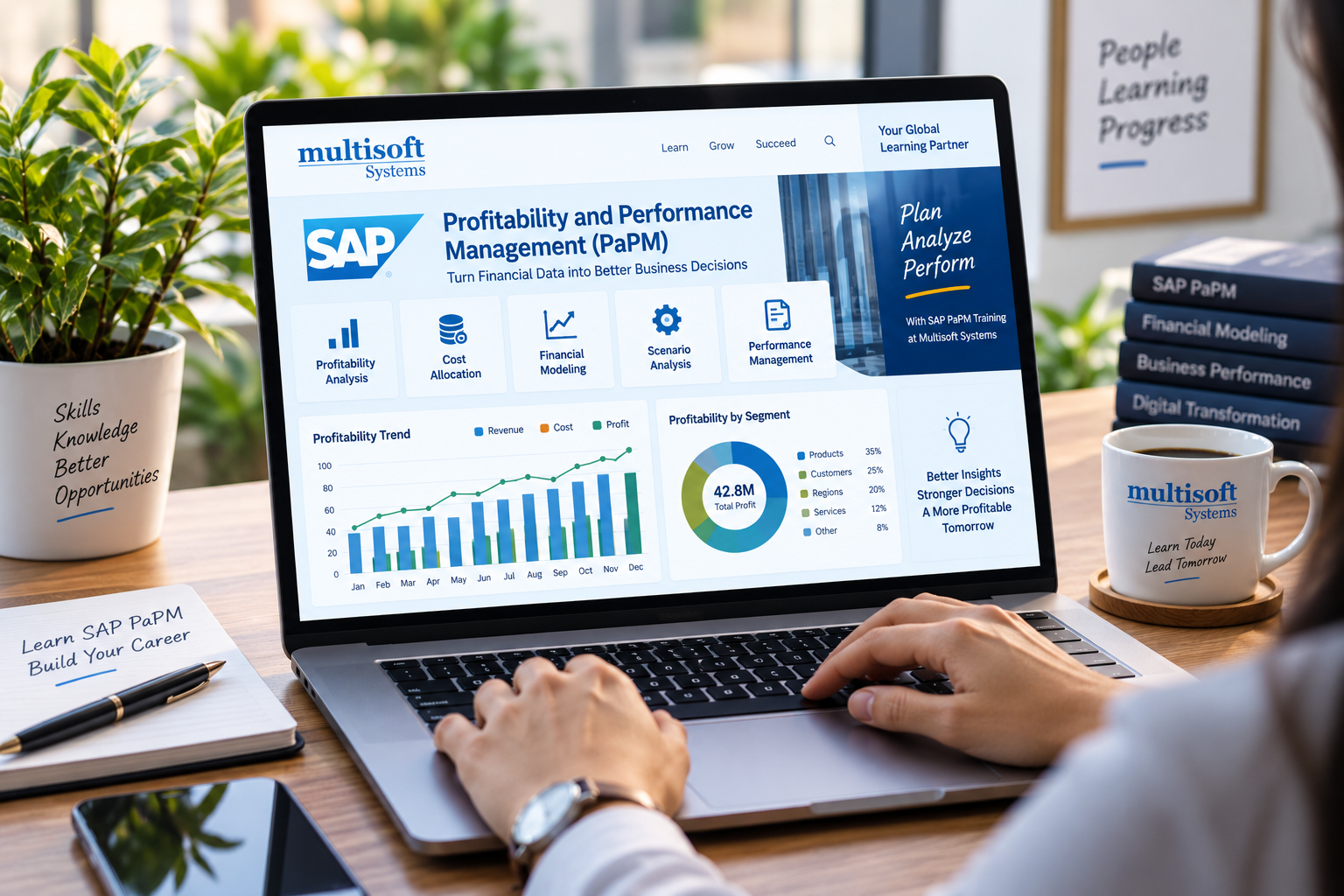
Modern organizations need more than traditional financial reporting to understand where profit is generated, where costs are increasing and how business decisions may affect performance. As companies manage large volumes of financial and operational data, they need flexible tools that can model complex business scenarios and provide meaningful insights. SAP Profitability and Performance Management (PaPM) Training helps professionals understand how SAP PaPM can be used for profitability analysis, cost allocation, financial modeling and performance management. The platform supports advanced business modeling and can work with SAP and non-SAP data sources to help organizations analyze costs, revenues and profitability at a detailed level.
Multisoft Systems offers a practical training program designed around SAP PaPM concepts, allocation models, calculations, data integration, processes and implementation. The published course includes 24 hours of hands-on training, instructor-led online learning, project-based activities, lifetime e-learning access and after-training support.
What Is SAP Profitability and Performance Management?
SAP Profitability and Performance Management, commonly called SAP PaPM, is an SAP application for advanced business modeling of complex processes. It can help organizations analyze profitability and costs at a granular level while supporting calculations, allocations and simulations. SAP describes PaPM as an application that helps maximize business performance and profitability through advanced business-centric modeling, granular profit and cost analysis and real-time decision support. One of the important strengths of PaPM is its ability to work with data from different systems and apply business rules to that information. This makes it useful when organizations need to understand profitability across products, customers, services, business units or other dimensions.
Why Is SAP PaPM Important?
Financial teams often work with data that comes from multiple business systems. Simply collecting this information is not enough. Organizations also need to understand how costs and revenues should be distributed and how different business activities contribute to overall performance. SAP PaPM provides modeling and calculation capabilities that can support these requirements.
It can help businesses with:
- Cost and revenue allocation
- Profitability analysis
- Financial calculations
- Business modeling
- Performance measurement
- Scenario analysis
- Data integration
- Planning and simulations
- Management reporting
- Decision support
SAP also highlights direct tax, operational transfer pricing and detailed profitability and cost analysis as important areas for the current solution.
How Does SAP PaPM Work?
At a basic level, SAP PaPM takes business data, applies defined rules or calculations and produces information that can be analyzed for financial and business decisions.
A typical workflow can include:
- Connecting to relevant data sources
- Bringing required data into the model
- Preparing and enriching the data
- Applying calculations or business rules
- Allocating costs or revenues
- Executing the model
- Reviewing calculated results
- Creating reports or simulations
- Using the results for business decisions
The exact workflow depends on the business use case and the PaPM model being developed. SAP documentation describes PaPM as a calculation and modeling environment that can integrate operational systems and data warehouses while supporting business modeling and analysis.
What You Learn in SAP PaPM Training
A well-structured SAP Profitability and Performance Management (PaPM) Course should cover both the concepts behind the platform and the practical process of building models. The Multisoft Systems curriculum includes five main areas: introduction and overview, allocation models, model development, allocations and processes, integration, implementation and management.
1. Introduction to SAP PaPM
The training begins with the fundamentals of SAP PaPM and its applications. Learners understand the purpose of the solution and how it can be used to support profitability and performance management. This foundation helps participants understand the terminology and overall architecture before moving into model development.
Key areas include:
- SAP PaPM concepts
- PaPM applications
- Profitability management
- Performance management
- Business modeling
- Basic solution concepts
2. Allocation Models
Allocation is one of the central capabilities of PaPM. Organizations may need to distribute costs or revenues across products, customers, departments, contracts or other business dimensions. The training introduces strategies for configuring allocation models and explains the building-block approach used within the solution. The Multisoft curriculum also includes sample content and practical modeling exercises. Learners can therefore understand how allocation logic can be structured instead of treating financial allocation as a purely manual activity.
Building the PaPM Model
Model development is another important part of learning SAP PaPM. Participants explore the environment function and calculation unit function and learn how different functions can be combined to create a working model.
The curriculum includes:
- Environment functions
- Calculation units
- Data source integration
- Data import
- Source data collection
- Data enrichment
- Calculations
- Model configuration
SAP documentation explains that a calculation unit can represent a financial or business unit on which calculations and analysis can be performed independently. It acts as a container for relevant functions, processes and activities. Understanding these concepts helps learners see how PaPM models can be organized around specific business requirements.
Data Integration and Data Preparation
Good financial analysis depends on reliable data. PaPM can work with information from SAP and non-SAP environments, making data integration an important part of the learning process. Professionals should understand where required data comes from and how it can be prepared for calculations and modeling.
Important areas include:
- Data source integration
- Data import
- Data preparation
- Data enrichment
- Data validation
- Source data collection
- Connections between systems
SAP's documentation explains that PaPM can integrate operational systems and data warehouses and can reuse existing data and information models in supported deployment scenarios.
Cost and Revenue Allocation
Cost allocation helps organizations understand how shared or indirect costs are distributed across different business areas. For example, an organization may need to distribute shared administrative costs across departments or allocate service costs across products and customers. The allocation rules depend on the organization's financial methodology. PaPM provides functions that allow organizations to build these allocation models.
Training helps learners understand:
- Allocation strategies
- Allocation rules
- Allocation models
- Cost distribution
- Revenue allocation
- Multi-step allocation processes
- Allocation results
SAP's current training materials also place strong emphasis on cost and revenue allocations within the Standard Model of PaPM Cloud.
Calculations and Business Rules
Not every financial scenario can be solved through a simple allocation. Organizations may need calculations based on business rules, formulas and different data relationships. SAP PaPM provides functions that allow users to construct calculation logic within models.
Learning this area helps participants understand how to:
- Define calculation logic
- Apply business rules
- Combine different data elements
- Create calculation functions
- Execute models
- Review results
This can make PaPM useful for complex financial and operational scenarios where standard reporting alone may not provide enough flexibility.
Processes and Event Management
A model becomes more useful when organizations can manage how and when different activities are executed. The Multisoft Systems curriculum introduces processes and event management along with integration, implementation and management. SAP PaPM also provides process management capabilities that allow organizations to manage and deploy processes. Learners can therefore develop an understanding of how models fit into broader business execution workflows.
Reporting and Performance Analysis
The purpose of modeling and calculations is ultimately to produce useful information. Once data has been processed, financial professionals need to examine the results and understand what they mean. PaPM supports reporting and analysis capabilities that can help users evaluate calculated information.
Reports can support questions such as:
- Which products are most profitable?
- Which customers generate stronger margins?
- Where are costs increasing?
- How are shared costs distributed?
- What happens when allocation assumptions change?
- Which business areas require further analysis?
SAP's current PaPM materials also cover report management and query functions within the solution.
SAP PaPM for Scenario Analysis and Simulations
Business decisions often involve uncertainty. Finance teams may want to compare different assumptions before implementing a change. PaPM can support modeling and simulation use cases that help users explore different scenarios. SAP describes the solution as supporting simulations and real-time decision-making based on financial and business models.
Scenario analysis can be useful for:
- Cost changes
- Pricing decisions
- Allocation changes
- Business restructuring
- Profitability analysis
- Financial planning
- Operational decisions
The objective is not simply to generate another report but to help decision-makers understand the potential impact of different assumptions.
SAP PaPM Cloud and the Universal Model
SAP PaPM is available in cloud-based offerings as well as established on-premise environments. SAP currently provides learning paths for both the Standard Model and the Universal Model of SAP Profitability and Performance Management Cloud. The Universal Model introduces a broader modeling approach and learning content covering foundations, modeling, administration and end-to-end accounting logic. SAP's current learning resources include separate courses for exploring foundations, modeling and administering the Universal Model. This distinction matters for learners because training content can differ depending on the PaPM deployment and model they are working with.
Who Should Attend SAP PaPM Training?
SAP PaPM is relevant to professionals who work with financial analysis, SAP solutions, business modeling and enterprise performance management.
The Multisoft Systems course identifies the following target audiences:
- Application Consultants
- Business Analysts
- Business Process Architects
- Business Process Owners
- Developers
- Development Consultants
- Enterprise Architects
- Business Analyst Consultants
- Solution Architects
- Subject Matter Experts
Team leaders and power users can also benefit from PaPM knowledge when they are involved in profitability analysis or financial modeling projects.
Prerequisites for SAP PaPM Training
According to the Multisoft Systems course page, learners should have basic knowledge of SAP HANA and Management Accounting. The course also recommends SAP01 or SAP01E SAP Overview Training. These foundations can make the training easier to follow because PaPM combines financial concepts with technical modeling and data-processing capabilities.
Before starting, learners can review:
- Basic SAP concepts
- Management Accounting fundamentals
- SAP HANA basics
- Financial data structures
- Cost and revenue concepts
- Basic business modeling
The exact prerequisite level can vary depending on the PaPM version and learning path.
Why Hands-On Practice Matters
PaPM is a modeling-oriented solution, so practical experience is important. Understanding terminology is useful but learners also need to know how models are created, configured, executed and analyzed. Multisoft Systems emphasizes hands-on learning and project-based training. Its course includes practical exposure to allocation models, data integration, calculations, processes and implementation concepts.
Hands-on practice can help learners:
- Create allocation models
- Work with calculation units
- Integrate data sources
- Apply calculations
- Test allocation logic
- Execute processes
- Review model results
- Understand integration scenarios
- Troubleshoot practical issues
This approach can make it easier to transfer classroom knowledge into real project situations.
SAP Profitability and Performance Management (PaPM) Certification
Professionals often search for SAP Profitability and Performance Management (PaPM) Certification when planning their learning path. It is important to distinguish between a training completion certificate and an official SAP certification. Multisoft Systems states that its PaPM program provides a course completion certificate after training. Official SAP learning and certification pathways are separate from a training provider's completion certificate. Therefore, professionals seeking an official SAP credential should verify the current SAP certification requirements and available certification path directly with SAP. Training can still provide valuable preparation by strengthening practical knowledge of PaPM concepts and applications.
Career Opportunities After PaPM Training
SAP PaPM skills can support professionals working in finance transformation, profitability analysis, business performance management and SAP consulting.
Potential roles include:
- SAP PaPM Consultant
- SAP Finance Consultant
- Business Analyst
- Financial Analyst
- Performance Management Specialist
- Profitability Analyst
- SAP Application Consultant
- Solution Architect
- Business Process Consultant
- Enterprise Performance Management Consultant
Career growth depends on practical experience, SAP knowledge, financial expertise and exposure to real implementation projects.
Why Choose Multisoft Systems?
- Instructor-led SAP PaPM Training delivered by experienced trainers
- Project-based and practical learning approach
- Hands-on exercises based on real-world business scenarios
- Comprehensive coverage of SAP PaPM concepts and applications
- Customized training schedules to suit professional requirements
- Guidance on building allocation and profitability models
- Practical understanding of data integration and calculation functions
- Course completion certificate after successful training
- Lifetime access to e-learning resources
- 24×7 after-training support for continued assistance
- Suitable for developers, business analysts, consultants and enterprise architects
- Focus on job-relevant SAP PaPM skills and practical implementation knowledge
A Simple Learning Path for Beginners
Professionals new to PaPM can follow a gradual learning approach:
Step 1: Understand SAP fundamentals
Build a basic understanding of SAP and financial processes.
Step 2: Learn Management Accounting concepts
Review cost, revenue, allocation and profitability fundamentals.
Step 3: Understand PaPM architecture
Learn about environments, calculation units and modeling concepts.
Step 4: Work with data
Practice data import, source integration and data enrichment.
Step 5: Build models
Create basic calculation and allocation models.
Step 6: Apply business rules
Use functions and calculations to represent financial logic.
Step 7: Execute and analyze
Run models and evaluate the results.
Step 8: Explore integration and processes
Understand how PaPM connects with wider SAP and business environments.
Step 9: Practice real scenarios
Apply the concepts to profitability, allocation and performance-management use cases.
This sequence can help beginners move from basic concepts toward practical modeling skills.
The Future of Profitability and Performance Management
Financial management is becoming increasingly data-driven. Organizations want more detailed visibility into profitability and costs and faster ways to evaluate business scenarios. SAP's current PaPM direction includes advanced business modeling, granular profitability analysis, direct tax and AI-supported business actions. Cloud adoption is also expanding the learning landscape. SAP currently provides cloud learning paths covering the Standard Model and Universal Model, including modeling, administration, process execution and reporting. For professionals, this means PaPM knowledge can extend beyond traditional financial reporting toward broader business modeling and decision support.
Conclusion
SAP Profitability and Performance Management provides organizations with a flexible approach to profitability analysis, cost allocation, calculations, business modeling and performance management. It can help financial and business teams turn complex data into structured insights that support better decisions. SAP Profitability and Performance Management (PaPM) Training gives professionals an opportunity to develop knowledge of PaPM concepts, allocation models, data integration, calculations, processes and implementation. Multisoft Systems combines instructor-led learning with hands-on exercises, project-based activities and practical scenarios. For SAP consultants, business analysts, finance professionals and enterprise architects, a strong understanding of PaPM can support work in profitability analysis and performance management projects. If you want to strengthen your SAP and financial modeling skills, a structured SAP Profitability and Performance Management (PaPM) Course can be a practical next step toward developing relevant expertise.
Start your SAP PaPM learning journey with Multisoft Systems and develop practical skills for modern profitability and performance management.